Research Activities
The MAT'ECO team has two main research areas.
Mechanical behavior and durability of bio-based composite materials
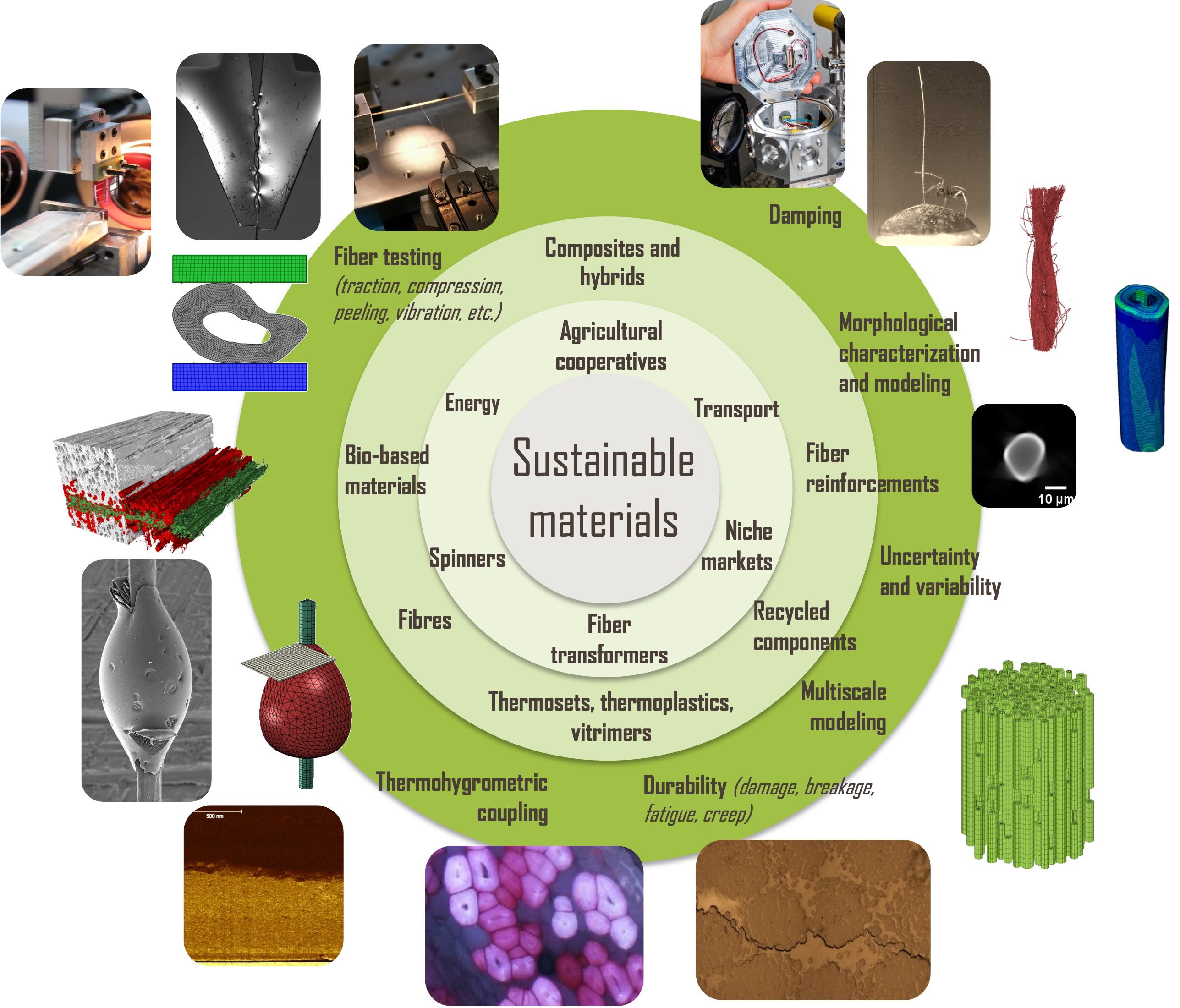
MAT'ECO has recognized expertise in the characterization and modeling of the thermo-hygro-mechanical behavior of bio-based composite materials and their constituents (plant fibers derived from annual crops, bio-based polymers, wood, and hybrid materials). The objective is to promote the large-scale use of renewable and recyclable materials derived from local agricultural and forestry resources in order to help reduce CO₂ emissions associated with material manufacturing processes.
The behaviors studied include viscoelasticity, damage mechanisms, the mechanisms responsible for stiffening phenomena, as well as thermo-hygro-mechanical couplings. At each scale, the relationships between manufacturing/processing methods, structure, resulting properties, and in-service performance are investigated.
The experimental approach supports the modeling of the various behaviors and phenomena studied at the relevant scales and under controlled hygrothermal and hydrothermal conditions. MAT'ECO develops original experimental devices, multi-scale homogenization approaches, micromechanical tools, and phenomenological formulations with strong physical foundations, implemented in finite element analysis software.
The long-term objective is to contribute to the development of reliable design-support tools for structures made from plant-fiber composites, offering a low environmental footprint, economic competitiveness, and increased functional integration.
Materials and structures for hydrogen storage
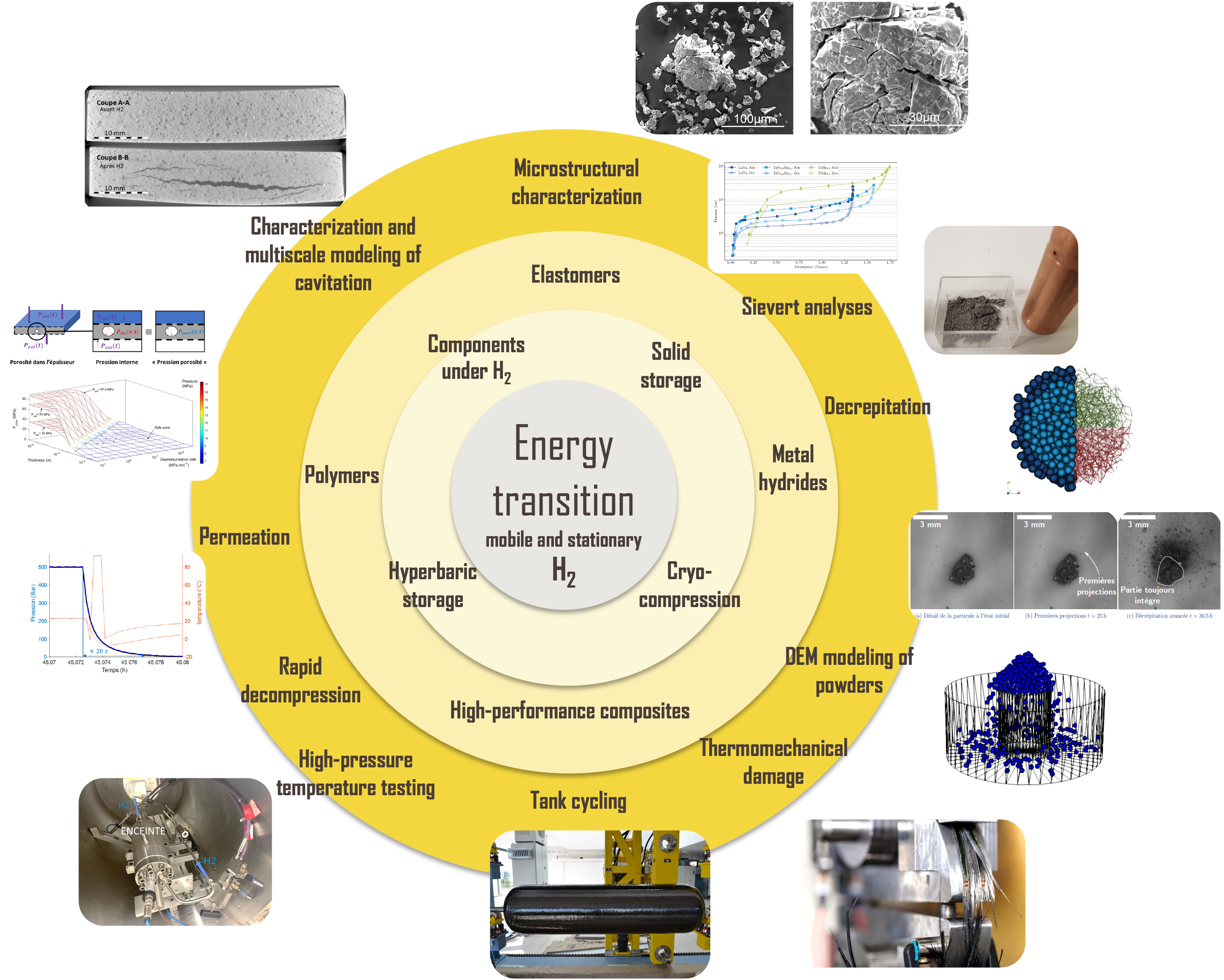
MAT'ECO is also involved in the field of hydrogen storage, both in compressed form and in so-called solid-state storage. The MAT'ECO team studies the behavior and multiphysics modeling of materials used in storage solutions, taking into account the severe stresses induced by high pressures as well as by hydrogen itself.
The research aims to support the deployment of hydrogen as an energy carrier by providing a better understanding of the degradation mechanisms affecting materials used in hyperbaric solutions—from the polymeric airtight liner to the structural reinforcement made of composite materials—as well as by investigating the phenomena associated with the formation of metal hydrides, such as phase changes, decrepitation, and the resulting mechanical effects on storage tanks.
Beyond the challenges associated with developing decarbonized solutions, this work also addresses issues related to large-scale deployment and public acceptance through considerations of the safety of hyperbaric systems, resource supply, and material recyclability.
The team is committed to conducting both numerical and experimental research simultaneously, through analytical, finite element, and discrete element modeling, as well as through the use of equipment specifically designed for hydrogen environments and internally developed experimental tools.